

by Leif Kullman
Radiation doses and radiation risks
Quite often I met patients complaining about their fear about ionizing radiation. Once, one of them was very anxious and I tried to explain that mankind is exposed to radiation from many sources, with medical diagnostic radiation as only one of the smallest. However, the patient declared - " Yes I can see that, but when I am exposed to almost the same dose during my flight to and fro the Canary Islands, I knew that I at least will have a lot of fun during my holidays!" Mankind is unexplainable.
Radiation from the cosmos and the earth has existed from times immemorial. Without it mankind would not exist in our high development level among the mammals. Radiation is energy and can be divided into ionizing(enough energy to remove tightly bound electrons in an atom) and non ionizing radiation (without enough energy to remove electrons in an atom).
Examples of non-ionizing radiation are visible light, microwaves, magnetic fields, laser, radiation from screens and radiation in a solarium. Examples of ionozing radiation are electromagnetic waves as nuclear radiation and x-rays. Due to its ability to ionize it is important to be careful with different kinds of ionozing radiation. Mankind is exposed to this radiation from different sources (see figure) and the medical diagnostic source contribution is only of minor magnitude. The dental source is included in the medical and is only about some percent of the total medical source.
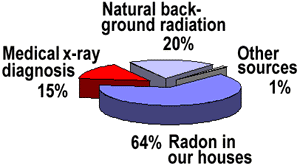
In spite of the small doses coming from medical diagnostic imaging it cannot be denied that some risk for a damage due to our diagnostic radiation is present.
What happens in the body? Ionozing radiation causes changes in the molecules of living cells. These changes are called ionizations and result in the removal of electrons from the atoms, which form ions. The formed ions can continue to react with other atoms in the cell, causing damage in the tissue. For example if the radiation ray passes through a cell, the water molecules near the DNA might be ionized and the ions might react with the DNA causing it to break. As a consequence a genetic defects has been created and this can follow this person and his coming generation. At low doses, such as those which we receive every day from background radiation, a cell can repair the damage , but at higher doses a cell often is not capable to repair the damage, and the cell may either be changed permanently or die. Most cells that die can be replaced by our body. However cells that are changed permanently may go on to produce abnormal cells. Since these cells may become cancerous, there is a cause of an increased risk for cancer due to radiation exposing besides the risk of a somatic body damage.
The calculated risks with radiation Accordingly there is always a risk to receive even a small radiation dose in a diagnostic purpose, this fact cannot be denied. We must therefore always have an ambition to keep the diagnostic radiation exposure in a minimum level and only use it when a gain can be expected. However most things in our world have potential risks. If the potential risks with different usual daily activities that mankind use are calculated the following statement can be proclaimed: The total radiation dose to the whole body from an intraoral fullmouth radiographic investigation is 1 to 2 milliSievert. The calculated death risk for this dose is about 5 deaths in 100.000 human beings. A person will be exposed to the same risk if he:
smokes 50 cigarettes
lives with a smoker during 5 years
drives a car for 500 kilometres
flies 50000 kilometres
paddles a canoe in 5 hours
lives about 3 weeks in a radon house
eats ten pastries
drinks 50 soft drinks
Leif Kullman

