

by Leif Kullman
MRI ( magnetic resonance imaging) - an expanding imaging technology.
Magnetic resonance imaging is a new technology which provides a powerful diagnostic tool for different pathologic conditions. It provides more precise tissue contrast and anatomic details than many other radiographic methods. The image is created by means of magnetic fields and radio frequency pulses and is thus, as far as we know today, harmless for mankind, while all conventional radiographic methods have a drawback- a ionizing effect in the tissues, with a biological risk.
The following is a VERY SIMPLE description of how it works: The main component of a MRI system include a magnet, radio frequency transmission and receiving coils and a computer.
The MR images are created under the influence of a strong magnetic field in which the patient is lying. When the patient is placed in this, the proton of the hydrogen nucleus of the body (as all other protons) becomes orientated either parallel or anti-parallel to the magnetic field (the charge and the spin of the nuclei causes them to behave like magnets). Hydrogen nucleus exist above all in the water in our body, which means in all tissues, but more in the soft tissues than in the hard tissues.
Radio frequency (RF) energy is then transmitted to the body and the body area of interest. When energy in the form of radio waves is added to the patient, the low energy state of the protons can change to a new high energy state. The radio frequency used is very specific and is called the Larmor Frequency. When this RF pulse is turned off, the protons will release the energy they absorbed. The protons now want to straighten themselves in the longitudinal direction, where they were in the first place.
To create an image of this released energy and its impact on the protons, the source and strength of the signal must be determined. This is performed by means of radio receiver coils, which detects the signal and the image can be built up.
As a consequence of the above mentioned it can be understood that the soft tissues of the body is best viewed in a MR image (see figure below). The MR signal is dependent not only on the presence or absence of hydrogen but also to whether hydrogen is bound tight or loosely within a molecule. Hydrogen in bone is tightly bound and the signal from bone will not be usable while hydrogen in liquids will tilt and a detectable signal is received. The higher concentration of loosely bound hydrogen nuclei we have, the more intense signal and brighter MR image we will have.
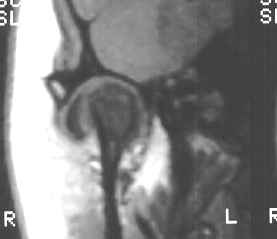
Figure: Example of a MRI picture from the TMJ (frontal aspect) of the authors
daughter. Note that the disc is placed lateral of the condyle.
There is a lot of parameters involved during a MRI investigation, all of them can have an influence on the resulting image. We shall only mention two of these MRI parameters to be able to understand a little more about the method, namely the usually used phrases T1-relaxation and T2 relaxation.
T1 relaxation concerns the time required for the protons to realign themselves with the main field of the magnet following an RF pulse. The time for the tissue protons to dephase caused by the magnetic field and following an RF pulse is called T2 relaxation. An image can now be weighted to consist mainly of either the T1 or T2 period andquite different images will be created during these periods.
Certain tissues, such as bone, fibrous tissue have little or no free water and are characterized by a low signal on both T1- and T2-weighted images
However the majority of tumours, inflammation and most pathologic foci increase the tissue's free-water content and radiate a low signal on a T1 image but a high signal in T2 images.
There is a lot of possibilities to get a signal difference between the tissues of the body with the MRI method. Only some of these differences in the signals are listed down under.
SUMMARY of image interpretation
General pathological processes such as tumour, inflammation and oedema in general.
T1-weighted images, low signal
T2-weighted images, high signal
Bone, cartilage, ligaments, tendons, and calcification
T1-weighted images, low signal
T2-weighted images, low signal
Serous fluid collections
T1-weighted images, very low signal
T2-weighted images, very low signal
Proteinaceous fluid collections
T1-weighted images, intermediate or high signal T2-weighted images,
high signal
Due to its excellent soft tissue contrast resolution has MRI proved to be useful in a variety of cases. In the head and neck region some of these are:
imaging of the salivary gland parenchyma different other soft tissue lesions including tumours internal derangements of the TMJ including the position of the disc osteomyelitis in the jaws
In the future a lot of new fields of application will show up for MRI, when we have learned more from the technique ourselves.
Next month I will describe small essential hints to keep a good quality in Dental Radiography.
Leif Kullman

