

by Leif Kullman
Teledentistry and communication
I believe that telecommunication will be an important subject for everybody in the future, not at least for dentists. Many human beings who are living in rural and remote geographical areas try to gain access to good specialty dental care and sometimes also a second hand opinion about their oral problems and diseases. Teledentistry may also permits dentists doing research to be linked together despite geographical separation, sharing patient diagnostic images and records. Education for dentists and their staff may as well be possible in the future by linking each other together or by means of Internet. We will therefore discuss this subject a little this month.
Teledentistry can be started after connecting two or more computers and by sending dental information. The transmission of dental data is started, including sending radiographic and photographic images from one place to another. This transfer of dental data may use the Internet, different Intranets, satellites, videoconferencing equipment and of course telephones.
It thus allows for establishing differential diagnosis and treatment planning of patients at remote sites from the healthcare provider.
A teledentistry system may contain three principle main parts:
1.A sending station (which have image acquisition possibilities)
2.A transmission network
3.A receiving station (with a possibility to review images)
The sending station can have a digital PC System and for images an image scanner or (film) digitizer. The most commonly used transmission networks currently in use for teledentistry are those provided by telephone companies (commonly both wire and fiber optics). A receive station consists in the same manner as the sending station of a network interface (modem, Internet) and a personal computer with a monitor. Some kind of hard copy device or printer is most often available.
Regarding the equipment, some important specifications for the sending and the receiving station are:
The compression
The resolution
The transmission speed
The gray level
With compression we mean a computer program by which some pixels in a digitized image can be dropped and the main idea with this is to decrease the transmission time. The resolution of an image system can be defined as the systems ability to differentiate the boundaries between objects in theimage. In digital imaging the number of pixels will influence this parameter. Usually a resolution matrix which is 512 pixels wide and 512 pixels high enough. When an image is read by a digitizer, the information contained in each pixel is assigned a number.This number represents the amount of radiographic density (information) it contains, and make up the gray scale (or density).
The transmission speed is very important. Digital data are converted to electrical impulses by a modem and can then be transmitted. The rate at which this can take place is given in bits per second (BPS) and it is very important to keep this time short.
Finally we have the gray level. Usually used scale ranges are 256 (8 computer bits deep) to 4096 (12 computer bits deep) shades of gray. In dentistry 8 bits (256 gray levels) is well adapted for teletransmission of images.
During a teleradiological session a referring clinician occupies one review station and the consultant specialist another (see example on picture below).
(Photo: Staffan Larsson, Huddinge Hospital, Stockholm)
.
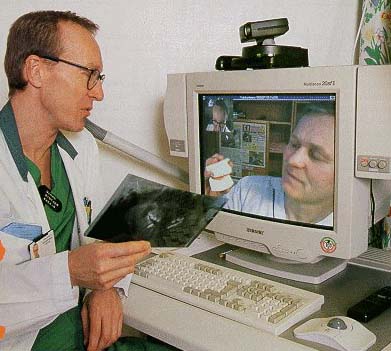
Both of them can review the same image (radiograph, clinical intraoral photograph) or the patient himself at the same time, usually with a simultaneous audio communication.
Sometimes the used systems allow each participant to manipulate an electronic pointer and identify and indicate interesting image structures during the consultation session.
One problem today is that the sending and receiving stations must have compatible equipment (software that can communicate). Today we have no communication standards for image file formats in the teleradiology market place and also none for different transmission schemes. However the manufacturers are working with this problem and we are slowly progressing toward a standardization in the future.
Leif Kullman

