

odontology
by Leif Kullman
An intelligent murderer
Some years ago a great number of fires occurred in different places in a rural area one night in the county of Småland. The small provincial fire brigade had no possibility to be in all places and in most places the fire must go out of itself. Several houses and cowhouse were completely destroyed.
An old brother and sister, living at the place disappeared the same night. The police and people living in the area started to search for them but they remained missing. Quite soon the police got a suspicion that this couple could have been murdered. A male, who knew this couple well, and who earlier had been condemned for pyromania became suspected to have killed them and to have started the fires. He was known to be an enemy of the brother and sister. The police started the difficult work to find some remnants of the couple in some of the places where the fires had taken place.
In one fire place the police technicians found a lot of small remnants of possible human bones and melted metal fragments. These things were sent to us and were investigated by a forensic medical examiner and the metallic fragments are also investigated in a scanning electron microscope. There was no possibility, however, to perform an identification The bones were heavily carbonised and it could only be concluded that it must be bone from a female. This could be stated by a specialist in osteology since a bit of the skull bone-os parietale was in the found material This bone has a boneridge in which a muscle inserts. In males this ridge is much bigger than in the actual case and it could therefore be concluded that these remnants were of a female origin. The found metal proved not to be of the same kind that is used by dental technicians, when they make gold crown. Accordingly no safe identification could be established, but the police suspected that the sister could have been found. This event took place before the DNA tests had became popular and well established.
The searching continued. In another fire place the policemen found some larger bone parts. They also found some teeth, unfortunately most of them carbonised and some was partly destroyed. All these remnants were sent to the department of Forensic Medicine in Solna.
The bony remains were handed over to the forensic pathologist for further examination and the forensic odontologist started to work with the remains which could be from teeth The police suspected that this discovery was the remains of the brother and we had earlier received the dental antemortem description of the brother. We therefore knew that he had several crowns and rootfillings and we had also received some antemortem radiographs from the dentist in Småland.
Among the carbonised postmortem material we found two almost intact crowns, one metallic ceramic crown and one porcelain crown. These two fitted with two crowns that the brothershould have according to the antemortem records and this fact was a weighty evidence for an identity but we wanted further evidences. Among the postmortem material a partly carbonised root from a molar was also available. We took a radiograph and found a very individual rootfilling (see figure 1). A rootfilling of the same appearance could be found in the antemortem records (see figure 2) and a safe odontological identification could be declared between the remains and the missing brother.
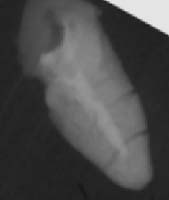
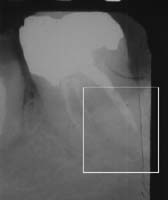
Figure 1, Figure 2
Turning point
The performed identification became one turning point in the investigation. Up to now the suspected male had denied every involvement during the interrogation. Furthermore one of the lead shot fired of the murderer had been found by us among the postmortem
material. The police now knew a little more about what had taken place. The murderer had shot the brother and sister and placed their bodies on two different places where he was going to set on the fires. He had also cut off the thumb of the brother and when he went around setting the fires, he had the thumb with himself and left the fingerprints in several places. Thus trying to put the responsibility on the brother.
When a lot of things now was pointing against him he admitted his involvement and could be condemned guilty.
Next month I will tell you a little more about bite mark identification, a difficult field of forensic odontology.
Leif Kullman

