

forensic- odontology
by Leif Kullman
The case with the fatal bottle blow.
Already at lunchtime a lot of beers and other strong drinks had been taken and it was a festive atmosphere in an apartment in one of the suburbs of Stockholm. The habitual drunkards had gathered there. Two of them, we can call them Ulla and Lars did not know each other so well and it is some irritation between them. Lars paws on Ulla, though she is not interested of Lars and she gets angry and suddenly she gets a knife from the kitchen. However, the others in the room assist each other to disarm her. But a few minutes later, when they are sitting at the table, Ulla suddenly take hold of a liquor bottle and hit it in the head of Lars. The bottle is crushed and during the following scuffle Lars gets a wound in the left cheek. He bleeds a lot from this and someone calls for an ambulance and Lars is taken to a hospital.
The examining doctor judges the damages and wounds as small, but the wound in the cheek is sutured and Lars depart from the hospital before they have finished everything. The doctor writes a testimonial that the injuries not were grave and that there will be no future disabilities for Lars.
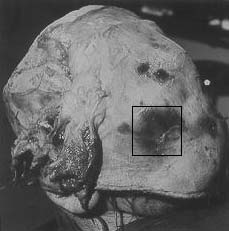
But, two days later Lars passes away. He is find dead in his apartment by his son. The autopsy reveals a bleeding in the soft tissues in the skull and an underlying subdural hematoma with an accompanying swelling of the brain. During the autopsy the cranium and head bone are dissected from the skin of the head. In the inside of the skin is then seen a 5 to 7 mm long bleeding combined with an elevation of thetissue (figure 1), resembling for example the impression of a rounded long side of a bottle. On the inner side of this, in the brain tissue the
large hematoma is seen, which is the indirect cause of death. It istherefore importan
 t
to register
t
to registerall this and photographs are
taken. However, knowing that
it can be difficult to see small
things like this in a
photograph it is also decided
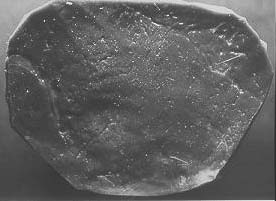
to take some impressions of
this tissue elevation and I am
asked to do this. I perform
this with a silicone impression
material (figure2).
Figure 1. The bleeding area
within the quadrant.
The impression and
the subsequent
manufactured cast in
plaster become very
successful. In figure 3
the plaster cast can
be seen
photographed with
light coming in from
one side.
Figure 2. The silicon impression.
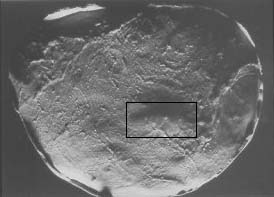
Figure 3. The cast in plaster with the interesting area within the
rectangle.
In the other photographs, taken directly of the involved soft tissue area during the
autopsy, the similarity with a side of a bottle was not as good.
During the trial Ulla denied being guilty to Lars` death, she only admitted assault and
battery. However the court was of another opinion. They were convinced, that the incidence
had taken place as the prosecutor claimed. The chain of circumstantial evidences seemed
unbroken. They had the crashed bottle with Ulla´s fingerprint and the subdural hematoma
could very possible come from a blow with this bottle in the head. Finally it was quite
clear that the cause of death was exactly this hematoma.
Ulla had behind herself a long criminal story, so the police was very satisfied with the
verdict. Only a couple of years earlier, she was strongly suspected to have committed
another murderer, but the evidences were very weak. Another alcoholic and criminal male
friend to Ulla was then stabbed to death and later on the dead body was put in a big
carton box and transported by means of a taxi to a bridge in another part of Stockholm,
where the box was thrown in the water. The driver was completely unknowing but became
suspicious during the ride. He contacted the police, who could pick up the body in the
water and initiate an investigation. Unfortunately the evidences were not enough that
time.
Next month I will relate an identification case where the identity of an
unknown dead could be established due to a known weight of a denture in the lower jaw.
Leif Kullman

