

forensic- odontology
by Leif Kullman
The case with the female
denture in an unknown dead male
Since 1980, it is desired in Sweden, that all kinds of dentures should be marked when they are manufactured. A marking should always be performed, the only reason not to do it being that the patient refuse. The reasons are manifold:
To be able to identify unknown dead persons
To be able to return found dentures
To be able to distinguish the dentures of patient in hospitals
The marking consists of a thin metal ribbon, made in stainless steel. This ribbon is placed within the plastic basis of the denture (see figure 1). In the ribbon the Social Security number (country code, year, month and date of birth, birth number and a control figure) of the wearer can be read. It has been written with an ordinary typewriter.
This ribbon is very durable and it can resist heating up to about 1300 degrees Celsius. It can therefore be used, even to identify people who has deceased in fires, with the bodies postmortem serious burned. Responsible for this marking is the dental surgeon, in cooperation with the dental laboratory, who makes the denture
.
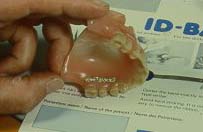
The dentist should check up that the marking is correct, when the denture is handed over to the patient for the first time. In the following case a technician had marked a denture with wrong numbers and the dentist forgot to check when the denture was delivered to the patient.
A male body is found dead in an apartment in Stockholm. The body has been laying there for a long time, and is in an advanced putrefaction stage. The identity of the person cannot be established in the usual police way, i.e. like confrontation or by comparison with photographs in identification cards.
When the police makes a supplementary examination of the body at the department of Forensic Medicine, before the autopsy, they find a full denture in the upper jaw with an identification ribbon. However the Social Security number does not suit to the suspected- the owner of the apartment, who was an elderly male. We can call him Bill.
A forensic odontologist is asked to assist. Can the dead person be Bill, the owner of the apartment and in that case have loaned the denture from someone else? The last figure in the birth number indicate that the wearer should be a female, since it is an even figure (for all males this figure is uneven and for females even in Sweden). My examination proves that the denture fits very well in the upper jaw, it cannot be manufactured for and subsequently borrowed from someone
else.
The police goes back to their headquarters and search in the computer on the Social Security number of the denture. It is in total accordance with a woman living in a suburb outside Stockholm. They also succeed to get in contact with some relatives to Bill, who know the name of the dentist that Bill visited. The dentist in his turn can report that he made a full denture in the upper jaw to Bill some years ago and he can also tell the police the name of the involved dental laboratory. A check up with the technicians reveals that they at the same time as they manufactured the denture to Bill they also made one to the woman. An interesting question now arise, does the woman have the Social Security number of Bill in her denture? It can be of importance in the future!
Inspite of the intricate question and unususal situation I call her, but she can verify that the number is correct in her denture. Now, how could the identification of Bill be carried out? Well, we was lucky enough to get some radiographs of a gold bridge in the lower jaw of Bill from his dentist, so a safe identification could be performed in an usual way based upon these crowns, which still were intact postmortem in the mouth.
Our case this month has described how a simple and useful identification method can be useless if the involved manufacturers have made careless mistakes. It is tempting to touch upon the thought that Bill had been one of the victims in an aircraft crash.
Could the woman from the suburb have been declared death in his place? With all probability not, but a lot of problem would have been created in the identification work. Furthermore we must ask ourselves, can we trust on denture markings? Yes, I think we can, thousands of dentures are made yearly in Sweden and every year many cases with unidentified human beings can be solved by means of all correct marked dentures.
The overwhelming mass of dentures are quite correct. In this case a small mistake was made in the laboratory and the dental surgeon was in a hurry and did not checked up when he should.
Next month I will report about an identification case, which went wrong. A mistake was made by the police which not was discovered until the presumed dead male was found highly alive in the prison.
Leif Kullman

