

Odontology
by Leif Kullman
Identification work after a mass disaster
One late Saturday evening in November 1983, a Boeing 747 bounded for Bogota in South America, was approaching the Barrajas Airport outside Madrid to make an intermediate landing.
Something went wrong, the aircraft approached in a too low altitude and crash-landed some kilometers outside the airport. A fire started at once after the smash down and only between 10 and 20 of those on board survived. On board the aircraft was almost 200 passengers, including about 30 Scandinavian citizens. Most of the victims were severely burned and therefore difficult to identify in a usual way, by means of confrontation, photographs etc.(figure 1).
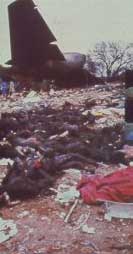
Figure 1.
When the crash became known in Sweden, the Swedish Ministry for Foreign Affairs, in cooperation with the Police authorities, decided to send the Swedish Identification Commission to Madrid (see more about this commission in my monthly message in November 1996). The permanent staff of this commission left already in Monday morning, after a preliminary contact with the Spanish authorities, which acknowledged the Swedish commission to assist them during the identification work.
Each member in this commission has his own substitute. While the permanent members left to Spain, to start their work there to collect all dental postmortem records of the victims, the substitute members stayed in Sweden to take control over and register all incoming antemortem records of the Swedish citizens. As fast as possible, all dental, medical and police antemortem records were collected by the Police. During the early morning hours in Tuesday most of these records had been registered in particular Interpol forms. There were very good dental descriptions (written records, radiographs etc.) of all Swedish citizens except four. Having finished this collecting the substitutes joined the rest of the commission who had started their work in a hangar at the Barrajas airport. When the substitutes flied down to Spain, during a short intermediate landing in Copenhagen, some additional antemortem material was handed over to them from the Norwegian, Finnish and Danish authorities. Denmark had had one, Finland one and Norway three citizens on board the aircraft.
Near the crash site in Madrid
In Madrid almost all victims had been transported to and placed in a hangar near the airport (figure 2). Since there are no laws in Spain for physicians or dentists to preserve their patient records for the future, forensic odontology are not yet any acknowledged speciality. During this accident the authorities carried out the identifications by means of the confrontation identification method. Relatives and acquaintances to the missing persons were allowed to go into the hangar to try to find the belongings or the body of their relative among the victims.
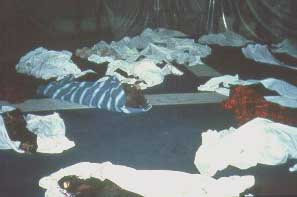
Figure 2.
Since we had a useful and objective identification material in our dental signalements, we were allowed to perform postmortem dental examinations on all bodies. All the time we kept an open communication with the Spanish police and showed them our forms and way of working. However the whole situation was of understandable reasons quite chaotic, with civilians sometimes walking around us during our work (figure 3).
As usually, when all postmortem examinations had been performed, comparisons between the ante- and postmortem examinations had to be carried out.
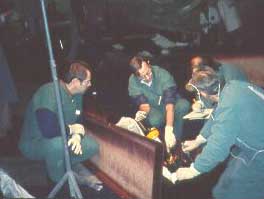
Figure 3.
But before we had finished all postmortem registrations, there was a possibility to find the body of some of our Scandinavian citizens. Consequently, we two dentists in the commission, had memorized characteristic illings, crowns and bridges of the Scandinavian citizen, and were directly able to confirm those we found after checking up with our antemortem forms. In this way our work slowly progressed and on the forth day after our start we could identify the last Scandinavian citizen.
The day after we assisted the Spanish police in trying to interpret the dental records, which they had received from different countries. We could for example establish a safe dental identification in one of the pilots and one of the stewardesses.
In the future
During the comparison between ante- and postmortem examinations it should have been of great value to if we had had access to a computerized identification program with a possibility to register all examinations. I have described this procedure in a foregoing message (October 1996). By means of such a program a first matching of ante- and postmortem examinations can be done. Today we have such a program, constructed on initiative of the international police organization Interpol.
Computer technology has come to the DVI (disaster victim identification) team and to forensic odontologist and our work during mass disasters. However to establish a safe and final identification the Forensic Odontologist is still and will in the future be necessary.
Next month I will ask a friend to write a little about new techniques for bite mark investigations. Handling with bitemarks is one of the greatest challenges for Forensic Odontology.
Leif Kullman

